Interview: Amit Sharma, Founder FitForge Gym
This interview is part of GymForce's "Built in India" series, where we speak with gym entrepreneurs who are building successful fitness businesses outside the metros. Amit Sharma founded FitForge Gym in Jaipur in 2021 and has grown it to over 1,000 active members across a single 4,000 sq ft facility. We sat down with him to understand his journey, challenges, and hard-earned wisdom.
Background & Starting Up
GymForce: Amit, thank you for joining us. Let's start at the beginning. What made you decide to open a gym in Jaipur in 2021, of all times — right in the middle of the pandemic?
"Honestly, I thought I was crazy. Everyone told me I was crazy. But I saw something that most people missed — people were desperate for fitness, for community, for a place to feel normal again. Jaipur didn't have a mid-market gym that offered both quality and community. That gap was my opportunity."
GymForce: Walk us through the early days. What did FitForge look like when you opened?
Amit Sharma: We started in a 1,200 sq ft space in Vaishali Nagar with a ₹12 lakh investment. Most of that went into basic equipment — a few treadmills, dumbbells, benches, and cable machines. I did everything myself: trained members, cleaned the floors, handled billing in a notebook, managed Instagram. My co-founder handled the finances. We had 47 members on opening day, mostly friends and family. Our first month's revenue was ₹1.8 lakhs. I remember thinking, "If we can just get to 200 members, we'll survive."
The Journey to 1,000 Members
Amit's path from 47 to 1,000 members was not linear. It involved experimentation, failure, and eventually, a set of repeatable strategies.
Year 1: 0 → 200 Members — Survival Mode
The first year was about building trust. "We didn't spend a single rupee on advertising," Amit recalls. "Every member came from a personal connection or word of mouth. I made it a point to know every member by name, their fitness goals, their kids' names. That personal touch was our only advantage against bigger gyms with better equipment." By month 8, FitForge had 200 members and was cash flow positive — barely. Revenue hit ₹4.2 lakhs per month, but Amit was working 16-hour days, seven days a week.
Year 2: 200 → 600 Members — The Turning Point
Year two brought two critical changes. First, FitForge moved to a larger 4,000 sq ft space in the same locality — a risky ₹8 lakh fit-out investment that nearly broke them. Second, Amit implemented a structured member referral programme. "We offered existing members one month free if they referred someone who stayed for three months. That single programme drove 40% of our new members in year two. We also started monthly community events — fitness challenges, nutrition workshops, weekend runs. The gym became a community hub, not just a place to work out."
Year 3: 600 → 1,000 Members — Systematisation
The leap from 600 to 1,000 came through systematisation. "We switched to GymForce in year two, and that was transformative," says Amit. "Automated billing alone saved me 15 hours a week — that's 60 hours a month I could spend on growth instead of admin. The member app reduced check-in time from 45 seconds to 5 seconds per person during peak hours. And the automated WhatsApp reminders cut our no-show rate for personal training sessions by 40%." By the end of year three, FitForge hit 1,013 active members with monthly revenue crossing ₹12 lakhs.
Technology Adoption: The GymForce Difference
GymForce: You mentioned switching to GymForce in year two. What was your setup before that, and why did you decide to make the move?
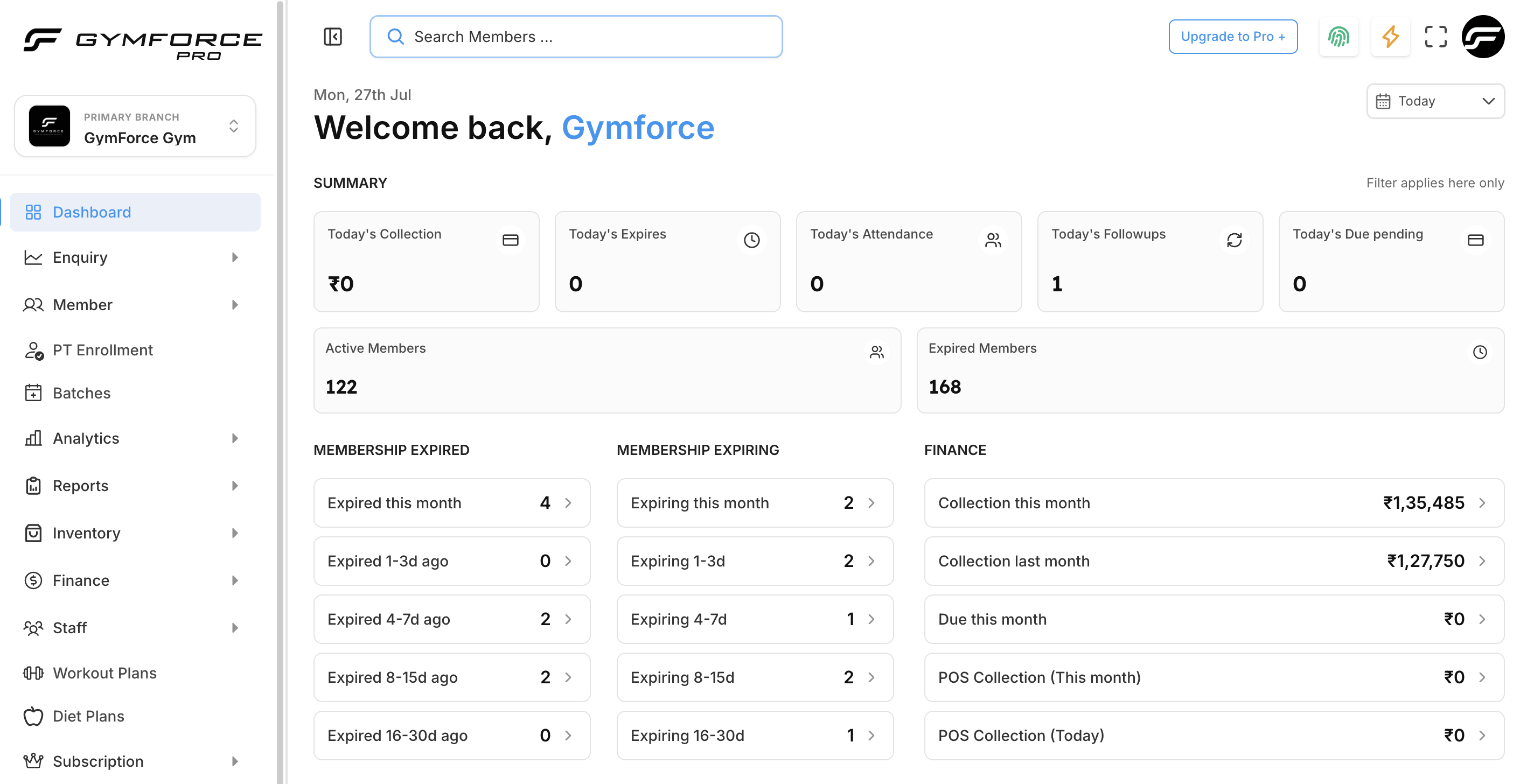
Amit Sharma: Before GymForce, we were using a combination of Excel sheets for member data, a basic billing software for payments, and WhatsApp broadcast lists for communication. It worked when we were under 200 members, but as we grew, the cracks showed. Members would complain about incorrect billing, I'd lose track of renewals, and we had no way to track attendance trends. A fellow gym owner in Pune recommended GymForce, and honestly, within two weeks of using it, I regretted not switching sooner. The billing automation alone was worth it. Now I can run my entire operation from my phone.
GymForce: What specific features made the biggest difference for your business?
Amit Sharma: Three things, in order:
- • Automated billing and UPI payments: Our collection efficiency went from 82% to 98% in the first month. Members loved the auto-pay option, and we stopped chasing late payments.
- • Member analytics: The dashboard showed me who hadn't visited in 7 days, who was at risk of churning, which classes had the best attendance — data I never had before.
- • WhatsApp integration: Automated reminders, renewal alerts, and promotional messages without any manual effort. We saw a 25% increase in class bookings within a month.
Challenges & Lessons Learned
GymForce: What were the hardest moments? What kept you up at night?
"The first time a trainer left and took 30 members with him — that was brutal. I realised then that your business can't depend on any single person except yourself. That's when I started systematising everything: training protocols, member communication, sales processes."
Amit Sharma: Staffing was our biggest headache. Finding qualified trainers in Jaipur is hard, and retaining them is harder. We lost three trainers in year two alone. Each departure meant losing members who were attached to that trainer. We've since built a training certification programme in-house and started offering profit-sharing to key trainers. That helped. Another challenge was retaining members during exam season — every January and June, we'd lose 40–50 student members who'd pause for exams. We addressed this by creating a "student pause" plan where they could freeze their membership for up to 60 days at half the monthly rate. Retention improved significantly.
GymForce: Competition from larger chains — how did you handle that?
Amit Sharma: A chain gym opened 500 metres from us in year three. We lost about 60 members in the first month. But we won most of them back within three months. The reason? We focused on hygiene and community in ways that chains couldn't replicate. Our equipment is cleaned after every use — not twice a day. Our staff knows every member's name. We have WhatsApp groups for different workout communities — runners, weightlifters, yoga practitioners. Chains have scale, but they can't compete on genuine connection. That's our moat.
Advice for New Gym Owners in Tier-2 Cities
GymForce: If you could go back to 2021 and give yourself one piece of advice, what would it be?
"Don't try to be everything to everyone. Find your niche and own it. For us, it was being the cleanest, most welcoming mid-market gym in the neighbourhood. We didn't need to have the most equipment or the cheapest price. We just needed to be the place people felt good coming to."
Amit Sharma's top advice for aspiring gym entrepreneurs in Tier-2 cities:
- • Start smaller than you think you need. A 1,200 sq ft gym with 200 members is better than a 5,000 sq ft gym with 100 members. Rent is your biggest fixed cost — don't overextend.
- • Invest in software before equipment. I spent ₹12L on equipment and zero on management software in year one. If I could redo it, I'd spend ₹2L less on equipment and invest in GymForce from day one.
- • Build a referral programme on day one. Paid ads in Tier-2 cities have terrible ROI. Word of mouth is 10x more effective. Give your members a reason to bring their friends.
- • Hire for attitude, train for skill. I've had certified trainers who were terrible with people and non-certified fitness enthusiasts who were amazing. You can teach someone how to spot a squat. You can't teach them to care.
- • Community beats equipment every time. A gym with basic equipment and a strong community will outlast a gym with premium equipment and no soul.
What's Next for FitForge?
GymForce: What does the future look like for FitForge?
Amit Sharma: We're opening our second location in Mansarovar, Jaipur, in February 2027 — a 5,000 sq ft space with a dedicated functional training zone, yoga studio, and recovery area. The plan is to open two more locations in 2028. But I'm not in a hurry. We've turned down three franchise offers because I want to get the model right first. The goal isn't to be the biggest gym chain in Jaipur. It's to be the most loved.
Related Articles
Gym Case Study: Scaling a Fitness Business in Jaipur
A detailed case study on building a successful gym in a Tier-2 city.
From Single to Multi-Location: Gym Scaling Case Study
How a single gym owner scaled to three locations in 18 months.
Gym Expansion Strategy: When and How to Open Location #2
A strategic guide for gym owners planning multi-location growth.
Key Takeaways
Amit Sharma's journey from a 1,200 sq ft space with 47 members to a thriving 1,000-member gym offers valuable lessons for any fitness entrepreneur. The combination of community-first thinking, smart technology adoption, and relentless focus on member experience created a business that competes successfully against well-funded chains. As Tier-2 and Tier-3 cities continue their fitness boom, Amit's playbook — start small, systematise early, build community relentlessly — provides a proven path for aspiring gym owners across India.
Run Your Gym Smarter with GymForce
From automated billing and member analytics to WhatsApp engagement and AI-powered retention insights — GymForce gives you the tools to focus on growth instead of admin. Join 500+ Indian gyms already using GymForce.
Start Free TrialSchedule Demo