Indian Fitness Industry Report 2027
The Indian Fitness Market at a Glance
The Indian fitness industry is on a trajectory that would have seemed unimaginable a decade ago. Valued at approximately ₹18,000 Cr in 2022, the market is projected to reach ₹35,000 Cr by 2027 — a compound annual growth rate (CAGR) of 14.2%. This growth is fueled by a confluence of rising health consciousness, government policy support, rapid urbanisation, and the digital transformation of fitness delivery models.
Market Snapshot (2027 Projections)
- • Total market size: ₹35,000 Cr (up from ₹18,000 Cr in 2022)
- • Organised gym chains: ₹12,000 Cr (34% of market)
- • Boutique & studio segment: ₹5,000 Cr (14% of market)
- • Unorganised sector: ₹18,000 Cr (52% of market)
- • Active gym-going population: 14 million (up from 7 million in 2022)
- • Total gyms across India: 65,000+ (estimated)
Key Growth Drivers
Several structural factors are propelling the Indian fitness industry forward, creating opportunities for operators, technology providers, and investors alike.
Rising Health Awareness
Post-pandemic, health consciousness has reached an all-time high across Indian demographics. A 2025 Ipsos survey found that 68% of urban Indians now prioritise fitness in their weekly routine, compared to 41% in 2019. This shift is most pronounced among the 25–40 age group, which accounts for 55% of gym memberships. The rise of fitness influencers on Instagram and YouTube has further normalised gym culture, especially in smaller cities.
Government Initiatives
The Fit India Movement, launched in 2019, has gained significant traction with state-level implementation. Tax incentives for gym setups under startup schemes, relaxation of licensing norms in several states, and inclusion of fitness in corporate wellness programmes under Section 80D of the Income Tax Act have all contributed. The Ministry of Sports & Youth Affairs has also announced plans to recognise fitness centres under a standardised accreditation framework.
Technology Acceleration
The adoption of gym management software has nearly doubled from 25% in 2024 to 45% in 2026. This digital transformation is enabling smaller gyms to compete with large chains by offering automated billing, member analytics, and engagement tools that were previously accessible only to premium operators. UPI-based payments, now used by 72% of gyms for membership collection, have reduced payment friction significantly.
Segment Breakdown
The Indian fitness market is highly fragmented, with three distinct segments operating at different scales and margins.
Organised Gym Chains (₹12,000 Cr)
This segment includes national and regional chains such as Cult.fit, Gold's Gym, and Talwalkars, along with emerging budget chains targeting Tier-2 and Tier-3 cities. Organised chains account for roughly 12,000 gyms across India. Average ticket size ranges from ₹12,000–₹25,000 annually. This segment is witnessing consolidation, with larger players acquiring boutique studios and regional chains to expand footprint.
Key trend: Several chains are moving toward franchise-light models, reducing capex burden on franchisees by offering branded management software and centralised marketing.
Boutique Studios (₹5,000 Cr)
Yoga, Pilates, CrossFit, cycling, and functional training studios represent the fastest-growing segment at 22% YoY. These studios thrive on community and specialisation, commanding premium pricing of ₹18,000–₹40,000 annually per member. The segment has grown from roughly 3,000 studios in 2022 to over 7,500 in 2026, driven by urban professionals seeking specialised training experiences over traditional gym environments.
Unorganised Sector (₹18,000 Cr)
The largest segment by value, comprising independent local gyms, multi-purpose fitness centres, and community-run facilities. These operations typically serve 200–800 members with basic equipment and minimal digital infrastructure. However, this segment is rapidly modernising: 38% of unorganised gym owners surveyed in 2026 reported plans to adopt management software within the next 12 months, representing a massive opportunity for technology providers.
Technology Adoption Statistics
The Indian fitness industry is undergoing a digital transformation, though adoption rates vary significantly by segment and region.
- • 45% of organised gyms now use dedicated management software (up from 25% in 2024)
- • 72% accept UPI payments for memberships (up from 38% in 2023)
- • 28% offer a member mobile app for check-ins and class booking
- • 15% use biometric access systems integrated with software
- • 34% run automated marketing campaigns (email/WhatsApp)
- • 12% have integrated wearable device data into member profiles
The gap between technology adopters and non-adopters is widening. Gyms using management software report 22% higher member retention and 18% lower administrative costs compared to those using manual processes. For the unorganised sector, the primary barriers to adoption are awareness (42%), cost concerns (31%), and perceived complexity (27%).
Regional Analysis: Tier-1 vs Tier-2/3
The geographic distribution of India's fitness economy is shifting. While Tier-1 cities remain the largest revenue contributors, the growth story is increasingly being written in smaller cities.
Tier-1 Cities: Saturation & Premiumisation
Delhi NCR, Mumbai, Bengaluru, Hyderabad, Chennai, and Pune account for 58% of organised gym revenue but are showing signs of saturation. New gym openings in these cities grew only 6% in 2026 compared to 18% in 2023. The focus has shifted to premiumisation — higher-priced offerings with better amenities, personal training bundles, and recovery services (cryotherapy, compression therapy). Average monthly membership in Tier-1 has risen to ₹2,800, up 14% from 2024.
Tier-2 & Tier-3 Cities: The Growth Engine
Cities like Jaipur, Lucknow, Indore, Coimbatore, Vizag, and Guwahati are growing at 28% YoY in gym memberships. Lower real estate costs (60% cheaper than Tier-1), rising disposable incomes, and aspirational fitness culture are driving this growth. The average membership price in these markets is ₹800–₹1,500 per month, with high volume potential. Franchise chains are aggressively expanding here, and local entrepreneurs are finding success with mid-sized gyms (2,000–4,000 sq ft) targeting the 300–800 member sweet spot.
Key Industry Trends Shaping 2027
Several transformative trends are redefining how fitness businesses operate in India.
AI Integration in Operations
Artificial intelligence is moving from buzzword to practical application in Indian gyms. Predictive churn models help operators identify at-risk members 4–6 weeks before cancellation, enabling targeted interventions. AI-powered scheduling optimises class timetables based on historical attendance patterns, and computer vision is being tested for form correction in strength training. While still early — only 8% of gyms use AI today — adoption is expected to triple by 2028.
Wearable & App Ecosystem Syncing
The integration of gym management platforms with wearables (Apple Watch, Fitbit, Samsung Galaxy Watch) and fitness apps (Strava, Google Fit, Apple Health) is becoming a competitive differentiator. Members increasingly expect their gym visits, workout data, and progress metrics to sync seamlessly across devices. Gyms offering wearable integration see 17% higher engagement measured by monthly visits, according to a 2026 GymForce user study.
Hybrid Fitness Models
The line between physical and digital fitness continues to blur. Hybrid models — where members have both in-gym access and a library of live-streamed/on-demand classes — are now offered by 22% of organised gyms. This model appeals particularly to members who travel frequently or have unpredictable schedules, reducing the likelihood of long membership pauses or cancellations. Hybrid members retain at 78%, compared to 63% for gym-only members.
Challenges Facing the Industry
Despite the optimistic growth story, the Indian fitness industry faces structural challenges that need addressing.
Staff Shortage Crisis
An overwhelming 65% of gym owners cite qualified staff shortage as their top operational challenge. Certified trainers are in high demand, with salaries rising 20–25% annually in Tier-1 cities. The lack of standardised certification programmes and career pathways makes it difficult to attract and retain talent. Many gyms report trainer turnover rates exceeding 40% annually, disrupting member relationships and forcing constant recruitment cycles.
Rising Real Estate & Operational Costs
Commercial real estate rents in prime locations have risen 15–20% across Tier-1 cities since 2023. Combined with rising electricity costs and equipment inflation (imported fitness equipment is 12–18% more expensive than pre-pandemic), margin pressure is intense. The average organised gym operates at 18–22% EBITDA margins, down from 25–30% in 2019. Operators are responding by reducing per-gym square footage and increasing focus on high-margin personal training and supplement sales.
Price Sensitivity in a Competitive Market
With the proliferation of budget gym chains offering memberships as low as ₹499–₹999 per month, price competition has intensified. Mid-market gyms face the squeeze — unable to compete on price with budget chains or on experience with premium studios. The key differentiator is increasingly community and service quality rather than equipment or price. Gyms that invest in member experience and retention programmes consistently outperform those competing purely on pricing.
Future Outlook: 2027–2028
Looking ahead, several themes will define the next phase of the Indian fitness industry's evolution.
- • Consolidation wave: Expect larger chains to acquire regional operators, creating 3–4 players with 500+ locations each
- • Tech-first gyms: New gyms will launch with integrated software, biometric access, and member apps as standard, not optional
- • Corporate wellness: B2B fitness partnerships with corporates will become a major revenue stream, projected at ₹4,000 Cr by 2028
- • Fitness tourism: Wellness retreats and destination fitness camps, particularly in Goa, Rishikesh, and Kerala, are a growing niche
- • Regulatory evolution: Standardised licensing and accreditation for fitness centres is expected, raising quality benchmarks across the industry
Related Articles
Fitness Tech Trends 2026: What's Shaping the Industry
A deep dive into the technologies transforming gym operations.
From Single to Multi-Location: Gym Scaling Case Study
How a single gym owner scaled to three locations in 18 months.
Advanced Topics Hub for Gym Owners
Strategic growth guides for fitness entrepreneurs.
Navigating the Opportunity
The Indian fitness industry at ₹35,000 Cr is no longer a niche — it is a mainstream economic sector with deep roots in consumer lifestyle spending. For gym owners, operators, and entrepreneurs, the message is clear: the market is growing, the consumer is ready, and the tools to build a professional, technology-enabled fitness business are more accessible than ever. Those who invest in systems, staff, and member experience today will define the industry's next chapter.
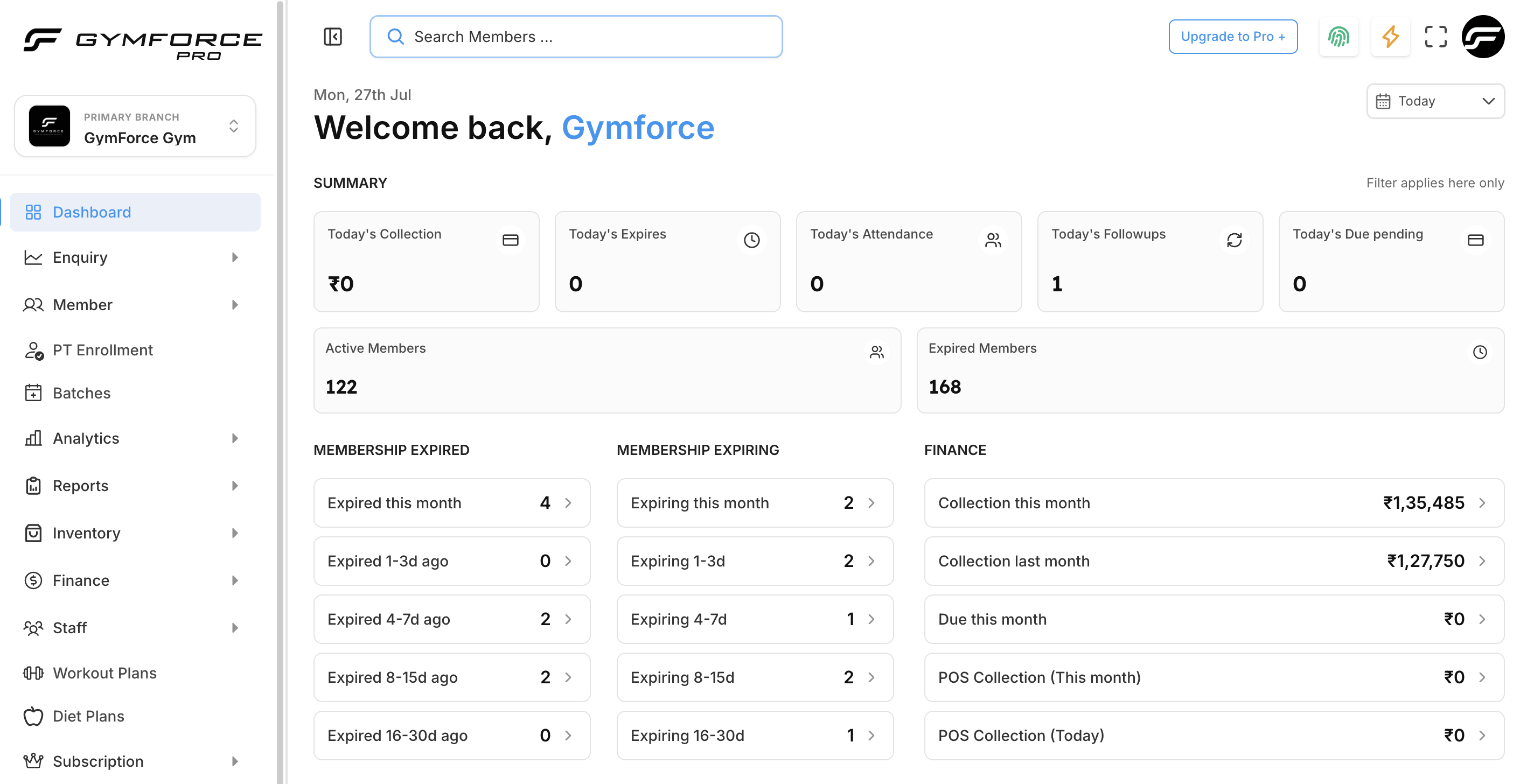
Build Your Data-Driven Gym with GymForce
GymForce is purpose-built for the Indian fitness market — from UPI AutoPay to AI-powered retention analytics. Start your free trial and join 500+ gyms running smarter operations.
Start Free TrialSchedule Demo